Program Integrity Is a Team Sport: Shared Responsibility in Self-Directed Care
By PPL on September 23, 2026

Program integrity is often seen as the responsibility of dedicated fraud, waste, and abuse investigators, but if everyone working in Self-Directed Care (SDC) thinks about PI, issues can be identified earlier, fixed faster, at lower cost, more effectively.
During a panel at the 2025 HCBS Conference, Tami Rogers from Arkansas DHS told us about the time she and other Arkansas SDC leaders sat down with the Office of the Medicaid Inspector General (OMIG) to discuss Program Integrity (PI) in the state’s self-directed care program.
Prior to this discussion, some OMIG staff may have held a common assumption — that SDC is at high risk for fraud.
“It’s not just one person’s responsibility. We all have to connect and work together.”
— Tami Rogers, Arkansas DHS
This often-voiced concern isn’t malicious or uninformed. Without seeing the checks and balances throughout the system, it’s easy to understand how an initial gut reaction can be “people are hiring their family and friends with state-granted money — of course many would take advantage.”
Then the state walked OMIG through how the program actually works.
Tami and her team showed how eligibility is checked and rechecked; how nurses, specialists, fiscal intermediaries, and state staff volley information back and forth in near real time to keep things moving efficiently. They explained how this ongoing communication between stakeholders (along with built-in reviews and meaningful multi-point reporting) surfaces problems early.
In that model, fiscal management services (FMS) companies become more connectors than enforcers. They help turn program rules into daily operations. Tools like electronic visit verification (EVV) mesh perfectly with this team-based approach. When used well, EVV helps with early identification of things like worker overlaps or excessive hours data that informs and drives education and behavioral change across the system.
Tami stated that, “after the meeting, OMIG were blown away, saying, ‘we had no idea!’”
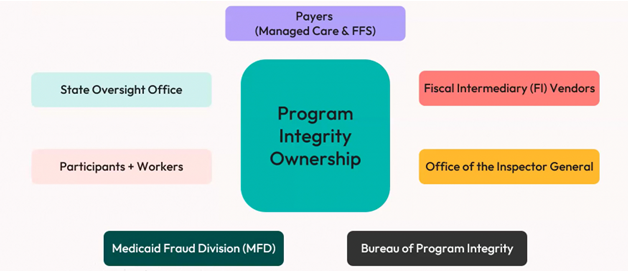
The moment illustrates something many Medicaid leaders discover over time: SDC program integrity shouldn’t sit only on the shoulders of the PI team. True success comes when responsibility is explicitly shared, baked into the program, reinforced in daily operations, and understood by all partners.
Last year’s overhaul of New York’s CDPAP underscores how important this becomes at scale: when programs become large and complex, PI can’t sit with any single unit — it has to be shared across the system with intent.
In other words, integrity isn’t assigned. It’s coordinated.
Why Siloes Fail
When integrity functions are siloed — eligibility in one place, service delivery in another, oversight somewhere else — programs don’t usually fail loudly. They fail quietly and, as a result, get discovered late.
Let’s look at just one element, eligibility, as an example (we’ll talk about the hidden PI power of eligibility next time).
When eligibility is siloed, it’s checked at enrollment and then largely taken for granted. If something changes later (a hospitalization, a coverage change, a waiver transition), systems don’t always catch up. Services continue to be delivered, and payments continue to go out based on outdated information.
The first time a problem is flagged might be months later during a scheduled audit. What follows is cleanup and pay-and-chase: recoupments, appeals, administrative work, and risk of service disruption for participants who didn’t do anything wrong.
No single stakeholder caused this problem. Siloing did.
State agencies are often well-aware of the pitfalls of siloing and many are taking steps to ensure PI is integrated into every step of the process. For example, one state is moving real-time eligibility validation into claims adjudication to fix issues when they are easy to fix. Pennsylvania’s Office of Long Term Living (OLTL)’s ongoing checks and front-end controls make eligibility errors rare.
Why This Matters So Much Right Now
Self-direction is growing. Programs are serving more participants and caregivers in more delivery settings, under more (often skeptical) scrutiny. At the same time, states are under pressure to modernize systems, prevent improper payments while protecting beneficiary choice.
A siloed integrity model can’t meet these demands and creates cases of inefficient post-payment recoupment.
“No one entity can have eyes on everything.”
— Liz Metcalf, Pennsylvania DHS
A team-based model builds in checks throughout the system, moves integrity upstream, and shares accountability so problems can be detected earlier, when they’re smaller and easier to resolve.
For Medicaid leaders, that’s the real takeaway. Program integrity isn’t just about having more, sharper eyes in one place. When it is an integral component of systems and process everyone is looking out for issues, it’s more efficient, less overall effort, and easier to fix problems earlier, more easily, and at lower cost.
In self-direction, program integrity works best the same way care does — as a team sport.
This is the first in a series of four stories about program integrity within self-directed care.