Self-Directed vs. Agency Home Care: What’s the Difference?
By PPL on August 26, 2026

Choosing home care for yourself or someone you love often means sorting through unfamiliar terms and models, usually while you are already stretched thin.
Two options you are likely to come across are self-directed care and agency home care. They can look similar from the outside, since both bring support into the home, but they work in very different ways.
The difference comes down to who is in charge of the care relationship. In one model, a company runs it for you. In the other, you run it yourself, with help handling the paperwork behind the scenes.
This article explains self-direction vs. agency care, including how caregivers are hired and managed and the practical tradeoffs, so you can see which one fits your situation.
What Is Agency Home Care?
Agency home care is provided through a licensed business that employs its own caregivers and sends them to your home. When you work with an agency, the agency is the employer. It recruits and screens the caregivers, assigns one to your case, sets the schedule, and supervises the work.
Because the agency runs the employment side, it also takes care of the administrative pieces that come with it, including payroll, employment taxes, training, and liability coverage. If your assigned caregiver is out sick or leaves the job, the agency is generally responsible for sending a replacement.
Agency care can be paid for privately or, in some cases, through a Medicaid program, depending on the agency and where you live. The tradeoff many families notice is having less say over exactly who shows up at the door, since the agency decides which of its employees is assigned to you.
What Is Self-Directed Care?
Self-directed care is a Medicaid-funded model that puts you in charge of your own care. Instead of a company assigning a worker to you, you choose the person who provides your care, decide when they work, and direct how tasks are done. In most programs, you or a representative acting on your behalf take on the role of employer for that caregiver.
One of the defining features of self-direction is the flexibility around who you can hire. In many programs, you can bring on a caregiver you already trust (like a family member or close friend) and pay them through your approved budget.
Because being an employer comes with a lot of responsibilities, self-direction programs bring in a financial management services (FMS) provider, sometimes called a fiscal intermediary. This organization handles payroll, employment taxes, and the required paperwork so you can direct your care without managing those tasks yourself.
You can learn more in our blog: What Is a Financial Management Services Provider in Self-Directed Care?
Self-directed care is not identical from state to state. Program names, eligibility rules, which services can be self-directed, and who you are allowed to hire all vary depending on where you live.
What the Two Models Have in Common
Before getting into the differences, it helps to know that these models share a common goal. Both are designed to help people receive support at home rather than in a facility, and both can provide many of the same kinds of everyday help, such as assistance with personal care, meals, mobility, and daily routines.
Both models also have rules to protect the people receiving care (caregiver screening and documentation requirements). The difference is in who holds the reins and how that oversight is structured.
Key Differences Between Self-Directed and Agency Home Care
Both models deliver support at home in different ways. Here are the differences that tend to matter most.
Who Chooses the Caregiver
- Agency Home Care: The agency selects a caregiver from its staff and assigns that person to you. You can usually share preferences and ask for a different worker, but the agency makes the match.
- Self-Directed Care: You choose your caregiver. You decide who is the right fit for your needs and your household, and you direct how your care is carried out from day to day.
What is Self-Directed Care? Read the full explanation here.
Hiring Family and Friends
Who you are allowed to hire is one of the biggest practical differences between the two models.
- Agency Home Care: Your caregiver is an employee of the agency, not someone you bring in yourself, so hiring your own friend or relative is generally not an option.
- Self-Directed Care: You can hire someone you already know and trust, such as a friend or family member, and pay them through your approved budget. For families already helping out informally, this can turn that support into a recognized, paid arrangement.
Rules about which relatives can be paid, and for which services, vary by state and program, so it is worth confirming the specifics where you live. For example, most states have rules against spouses becoming as caretakers.
Backup Coverage and Reliability
If your caregiver is out sick or unavailable, the two models handle coverage very differently.
- Agency Home Care: The agency usually takes responsibility for coverage and arranges a substitute so you are not left without support.
- Self-Directed Care: Arranging backup is your responsibility, which is why many participants line up an additional approved caregiver ahead of time.
This is one of the tradeoffs that comes with having more control.
Who Handles Payroll, Taxes, and Paperwork
Someone has to manage payroll, tax withholding, and required filings, and who does it is a core difference.
- Agency Home Care: The agency manages all of the employment administration internally, bundled into the service you receive.
- Self-Directed Care: The FMS provider handles this work. They process your caregiver’s pay using your authorized budget, withhold and file employment taxes, and keep the required documentation in order.
This is what lets you be the employer in self-direction without taking on the tax and payroll burden alone.
Day-to-Day Oversight
Day-to-day supervision of the caregiver falls to different people in each model.
- Agency Home Care: Supervision is part of the service. The agency oversees the caregiver’s performance and steps in if something is not working out.
- Self-Directed Care: You provide the oversight. You set expectations, manage the working relationship, and address issues directly, while the FMS provider supports the financial and administrative side.
In self-direction, the care relationship itself is yours to manage.
Cost and Funding
Cost works differently here than it does when someone pays for a caregiver entirely out of pocket.
- Agency Home Care: Services may be billed to a Medicaid program or paid privately, depending on the agency and your eligibility.
- Self-Directed Care: Care is funded through Medicaid and paid from an authorized budget instead of your own savings. The FMS provider’s services are usually covered by the program rather than taken out of that budget.
The more useful question is usually not which model is cheaper, but which funding path you qualify for and how you want your care managed.
Which Model Might Be Right for You?
There is no single right answer, since the better fit depends on your priorities and how much of the management you want to take on.
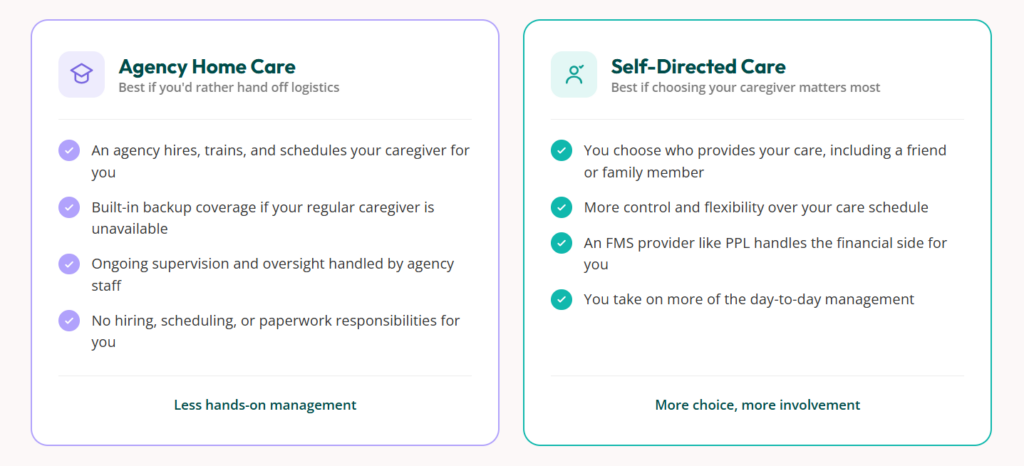
Read more about the benefits of self-directed care.
It also helps to know how each option is funded. Self-directed care runs through Medicaid, so eligibility is tied to qualifying for your state’s program. If you are weighing your options, looking into which programs are available where you live is a useful next step.
Is Self-Directed Care Right for You?
If self-directed care sounds like it could fit your situation, the clearest next step is to find out whether you or your loved one qualifies and whether it is a good match for your needs. It is not the right choice for everyone, but for many people it offers a level of control and flexibility that agency care cannot.
You can take a short questionnaire to see if self-directed care could work for you or the person you support.
Take the QuestionnaireAbout PPL
Public Partnerships (PPL) is a financial management services provider focused entirely on self-directed care. PPL supports roughly 50 self-direction programs across the country, has helped facilitate more than 700,000 participant and caregiver relationships, and has processed over $10 billion in goods and services payments.
PPL is not a home care agency and does not assign caregivers or provide direct care. Instead, PPL handles the administrative side of self-direction, including payroll, taxes, enrollment paperwork, and compliance, so that participants can direct their own care with confidence. To see which programs PPL supports in your state, visit the state programs page.
Explore Programs by StateFrequently Asked Questions
In self-directed care, you choose and oversee your own caregiver while a financial management services provider handles payroll and taxes, whereas in agency home care a licensed company hires, assigns, and manages the caregiver for you. The main distinctions come down to who selects the worker, who supervises them day to day, and who arranges backup coverage.
In many self-directed care programs, you can pay a family member to be your caregiver. You can hire and pay a qualifying friend or relative to provide your care, though some states limit which relatives can be paid for certain services. Agency home care generally sends the agency’s own employees, so hiring your own relative is usually not an option.
With agency home care, the agency usually arranges a substitute worker when your regular caregiver is out. In self-directed care, arranging backup coverage is typically your responsibility, so many participants keep a second approved caregiver ready in advance.
A financial management services provider, sometimes called a fiscal intermediary, processes payroll and manages employment taxes for participants in self-directed care. This lets you act as the employer of your caregiver without handling the tax filings and paperwork yourself.