What Is Agency with Choice? How It Compares to Self-Direction’s Employer Model
By PPL on October 23, 2026

If you’re exploring self-direction, you’ve probably noticed that the terms can start to blur together. Two you may run into are Agency with Choice and the Fiscal/Employer Agent model. The good news is that with both, you get to choose who provides your care, and in many programs that can be a friend or family member you already trust. The main difference is who the official employer is. We’ll walk through what each one means and what it could look like for you day to day.
New to self-direction? You may want to start with our blog, “Understanding Self-Directed Care: What It Is and How It Works,” before coming back to this resource.
Quick Definitions
Self-direction comes with a lot of vocabulary, and some of it overlaps. Here is how the terms in this article fit together:
- Fiscal/Employer Agent (F/EA): A self-direction model in which you, or a representative acting on your behalf, are the legal employer of your caregiver.
- Agency with Choice (AWC): A self-direction model in which an agency is the legal employer of your caregiver, while you choose and direct their work.
- Financial Management Services (FMS) provider or fiscal intermediary (FI): The organization that provides administrative and financial support within a self-direction program, such as processing payroll and handling employment taxes.
In other words, F/EA and AWC describe how the employer relationship is structured. An FMS provider or fiscal intermediary is the organization that carries out the administrative work. To learn more about FMS providers, see our blog, “What Is a Financial Management Services Provider in Self-Directed Care?“
The Centers for Medicare & Medicaid Services (CMS) also describes a few less common variations, including a government-run version of the F/EA model and a public authority model used in some states. Terminology can also differ from one state to the next, so the names in your program’s materials may not match these exactly.
What Is Agency with Choice?
Agency with Choice is a shared-employer setup. You and an agency split the employer role for your caregiver, and each of you handles different parts of the job.
- The agency is your caregiver’s official employer. It hires them and takes care of the legal and paperwork side of being an employer.
- You’re the managing employer. You (or a representative you choose) pick your caregiver and direct their day-to-day work.
This is also how the CMS describes it. You may also see it called co-employment.
Here’s what that usually looks like day to day:
- You choose your caregiver. In many programs, this can be a friend or family member, depending on your program’s rules.
- The agency hires them. Your caregiver goes through the agency’s hiring process and becomes an agency employee.
- You direct the care. You set the schedule, explain how you want tasks done, and oversee the day-to-day support.
- The agency handles the employer paperwork. That includes payroll, tax withholding, and employer compliance requirements.
Agency with Choice is typically offered through Medicaid programs that help people get care at home or in their community, including waiver programs and state developmental disability programs. Whether it’s available to you depends on your state and program.
What Is the Fiscal/Employer Agent Model?
In the Fiscal/Employer Agent model, you’re your caregiver’s employer. That might sound like a big job, but you don’t do it alone. A financial management services (FMS) provider works alongside you as your employer agent, handling the payroll and tax side so you can focus on the care. (In legal terms, you’re the “common-law employer,” which simply means you hold the official employer role.)
Here’s how the work is typically divided:
- You, or a representative you choose, are the employer. You recruit, hire, and supervise your caregiver, and if it’s ever not a good fit, you can make a change.
- Your FMS provider handles the paperwork. It processes your caregiver’s pay using your approved budget, withholds and files employment taxes, and manages the related forms.
The CMS describes this model as offering the highest level of choice and control, with less of the employer workload falling on you. It can also work in programs where you manage an individual budget (sometimes called budget authority) on top of hiring and managing your caregivers.
How Agency with Choice and the Employer Model Compare
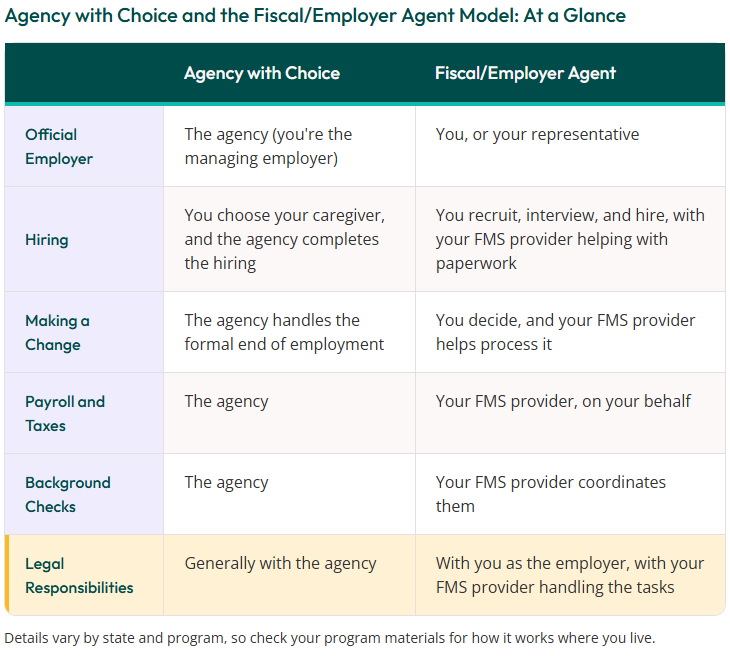
Both models let you choose your caregiver and direct your care. The main difference is who the official employer is, and that shapes who handles what. Here’s the quick version, with more detail below.
Who’s Your Caregiver’s Official Employer?
- Agency with Choice: The agency is the official employer, and you’re the managing employer.
- Fiscal/Employer Agent: You, or your representative, are the employer. In legal terms, that’s called the “common-law employer.”
Who Hires Your Caregiver?
- Agency with Choice: You choose your caregiver, but the agency completes the formal hiring, so your caregiver needs to meet the agency’s hiring requirements.
- Fiscal/Employer Agent: You recruit, interview, and hire directly, within your program’s rules. Your FMS provider helps with the enrollment paperwork.
What If It’s Not a Good Fit?
- Agency with Choice: In many programs, you can decide you no longer want a caregiver working with you. Because the agency is the official employer, it handles the formal end of employment.
- Fiscal/Employer Agent: As the employer, you decide whether to make a change, and your FMS provider helps process it.
Who Handles Payroll and Taxes?
- Agency with Choice: The agency processes payroll and handles employment taxes.
- Fiscal/Employer Agent: Your FMS provider processes payroll and withholds, files, and pays employment taxes on your behalf.
What About Background Checks and Getting Started?
- Agency with Choice: The agency handles required background checks and onboarding as part of its hiring process.
- Fiscal/Employer Agent: Your FMS provider coordinates the background checks and employment verification your program requires, such as Form I-9, before your caregiver can begin.
Who’s Responsible for the Legal Side?
This is where the two models differ most in practice, so it’s worth a closer look. You may also see this called legal liability.
- Agency with Choice: Because the agency is the official employer, it generally holds primary responsibility for employer obligations like employment taxes, labor law compliance, and workers’ compensation coverage.
- Fiscal/Employer Agent: You’re the legal employer, but you’re not handling it alone. Your FMS provider takes care of the employer tasks that come with the role, and CMS notes that it helps make sure required taxes are withheld and paid and that labor and workers’ compensation requirements are met. Under federal rules for employer agents, you and your FMS provider share responsibility for federal employment tax withholding.
Not sure what your specific responsibilities would be? Your case manager, your program materials, or your FMS provider can walk you through how it works in your program.
What Support Do Caregivers Get?
With Agency with Choice, caregivers may get a little more built-in support. CMS notes this can include training opportunities and a single employer to bring concerns to. With the Fiscal/Employer Agent model, your caregiver works directly for you, and your FMS provider supports the payroll and administrative side. Either way, caregiver training may be offered, depending on your state’s requirements.
What’s the Same in Both Models?
- You review and approve your caregiver’s time, since you’re the one who knows what care was provided.
- Background check requirements vary by state and program.
How Agency with Choice Differs From Traditional Agency Care
It’s easy to mix up Agency with Choice and traditional agency home care, but they work very differently.
With traditional agency care, the agency picks which of its employees to send, sets the schedule, and supervises the work. You generally can’t hire your own friend or relative.
With Agency with Choice, you still choose your caregiver and direct their work. The agency’s role is mainly administrative, handling the employer side of things behind the scenes.
One thing to keep an eye on: CMS notes that if an Agency with Choice agency starts operating like a traditional agency, you can lose some of the choice and control that self-direction is meant to give you.
For a closer look at how traditional agency care compares to self-direction, read our related blog, “Self-Directed vs. Agency Home Care: What’s the Difference?“
Which Model Might Fit You?
Neither model is right for everyone. The better fit depends on how much responsibility you want and what your program offers.
Agency with Choice may be a good fit if you:
- Want to choose your caregiver but would rather have an agency be the official employer
- Are comfortable with the agency’s hiring requirements and processes
The Fiscal/Employer Agent model may be a good fit if you:
- Want the most direct control over hiring, supervising, and managing your caregiver
- Are comfortable being the official employer, knowing your FMS provider handles payroll and taxes
- Want to manage an individual budget, if your program offers it (this is sometimes called budget authority)
Feeling unsure about being the employer? That’s a common worry, and you don’t have to take it on alone. Many programs let you choose a representative, like a trusted family member or friend, to help manage those responsibilities. You can also read the guide, “Debunking Common Myths About Self-Direction” for answers to other common concerns.
One more thing to keep in mind: what’s available depends on where you live. Some states offer only one model, while others offer both.
Is Self-Directed Care Right for You?
If you want to choose your own caregiver and direct your care as the employer, the Fiscal/Employer Agent model may be a strong fit, with an FMS provider handling payroll, taxes, and paperwork behind the scenes. To see whether self-directed care is a good option for you or a loved one, take our short questionnaire below. You can also find your state program to learn what is available where you live, or read how to hire and manage a caregiver under self-direction.
About PPL
Public Partnerships (PPL) is a Financial Management Services provider that supports self-direction under the Fiscal/Employer Agent model. PPL does not operate as an Agency with Choice, is not a home care agency, and does not assign caregivers or provide direct care. Instead, PPL helps participants serve as the employer of the caregivers they choose by handling payroll, employment taxes, enrollment paperwork, and compliance. PPL supports approximately 50 self-direction programs across the country.
Frequently Asked Questions
Agency with Choice is a self-direction model in which an agency serves as the legal employer of your caregiver while you choose the caregiver and direct their day-to-day work. It is a co-employment arrangement, with the agency as employer of record and you as the managing employer.
A managing employer is the participant or representative in an Agency with Choice model who chooses, schedules, and directs the caregiver. The managing employer does not hold full legal employer responsibilities, which stay with the agency.
In Agency with Choice, an agency is the legal employer of your caregiver. In the Fiscal/Employer Agent model, you or your representative are the legal employer, and an FMS provider handles payroll and taxes on your behalf.
Many Agency with Choice programs allow you to choose a friend or family member as your caregiver, as long as they meet the agency’s hiring requirements. Rules about which relatives can be paid vary by state and program, so check with your program first.