How to Get Enrolled in Self-Directed Care: A Step-by-Step Guide
By PPL on November 3, 2026

If you or a loved one has decided self-directed care might be a good fit, the next question is usually, “How do I get started?”
Enrollment can feel like a lot at first. There are applications, assessments, plans, and paperwork. Several people and organizations are involved, too. The good news is that most people follow the same basic path, and each step builds on the one before it.
This guide walks you through that path, from checking your Medicaid eligibility to your caregiver’s first paid shift. If you’re still learning the basics, start with our blog, “Understanding Self-Directed Care: What It Is and How It Works.” It’s a good foundation for everything below.
What Is Self-Directed Care?
Self-directed care is a way to get home and community-based services where you choose and manage the people who help you, instead of an agency doing it for you. It’s paid for mainly through Medicaid. You decide who provides your care and when they work, within your program’s rules. Many people hire someone they already know, like a family member or friend.
How Is Self-Direction Different From Agency Care?
With traditional agency care, a home care agency hires, schedules, and pays the caregiver, and it usually assigns someone to you. With self-directed care, you choose your caregiver and help guide the care. A Financial Management Services (FMS) provider handles payroll and taxes so you don’t have to.
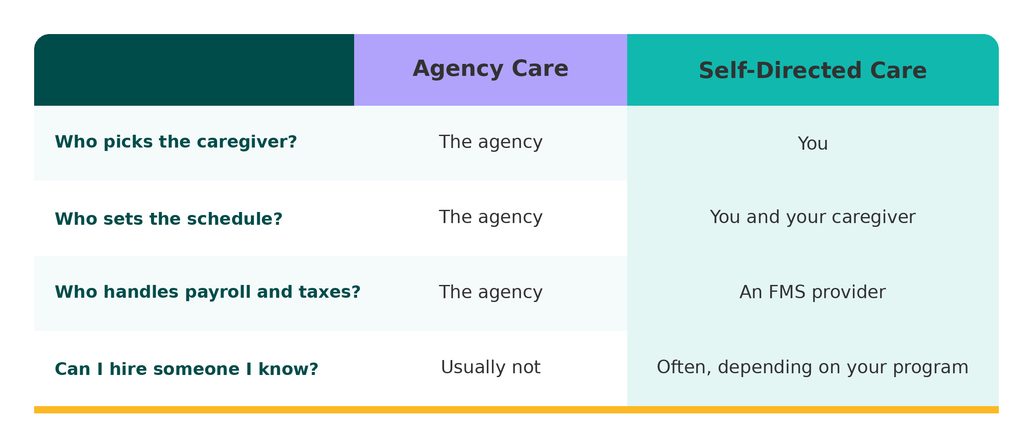
You may also hear about “Agency with Choice.” It sounds like agency care, but it’s actually a type of self-direction. You still choose your caregiver, and an agency acts as the legal employer.
Who Is Self-Directed Care For?
Self-directed care can work for many people, including older adults, people with physical disabilities, and people with intellectual or developmental disabilities. Who qualifies depends on your state and program. What many participants share is a wish to stay at home and in their community, with support from people they know and trust
If you’re an older adult weighing your options, our blog, “Aging Adults, Self-Direction and Their Best Long-Term Care Option” explains how self-direction can fit into long-term care planning.
The Steps at a Glance
Here’s the whole journey in a nutshell. We’ll go into more detail on each step later in this guide.
- Learn about self-direction and decide if it fits. Self-direction gives you more control, and more responsibility. Take some time to see if it feels right for you.
- Apply for Medicaid, if you’re not already enrolled. Most self-directed programs are paid for by Medicaid, so this usually comes first.
- Complete a needs assessment. A trained assessor talks with you about your health and daily needs so your state knows what help you should get.
- Enroll in a program that offers self-direction. This is a home and community-based services (HCBS) program, sometimes called a waiver.
- Choose self-direction. In most programs, you can pick between self-direction and a traditional home care agency.
- Build your care plan and budget. You and your case manager decide which services you’ll receive and how they’ll be paid for.
- Sign up with a Financial Management Services (FMS) provider. This is the organization that handles payroll, taxes, and reports so you don’t have to.
- Choose and hire your caregiver. Many people hire someone they already know, like a family member or friend.
- Get the green light and start services. Once everything is approved, your caregiver can start working and getting paid.
Does Self-Directed Care Work the Same in Every State?
No. Self-directed care is funded mainly through Medicaid, and each state designs its own programs within federal guidelines. That means the steps to enroll, the order they happen in, and how long the process takes can vary depending on where you live and which program you join.
Your state Medicaid agency, case manager, or health plan can explain how it works in your area. Learn how self-direction differs by state.
The person who helps you build your care plan also goes by different names depending on the state. You might hear case manager, care coordinator, or service coordinator. These titles all describe the same role: the person who helps you create your plan and connect with services. In this post, we’ll use “case manager.”
How to Enroll in Self-Directed Care, Step by Step
Enrollment looks a little different in every state and program, so think of these steps as a general outline. Your case manager or state Medicaid agency can tell you exactly how it works where you live.
Step 1: Learn About Self-Direction and Decide If It Fits
Self-direction comes with more responsibility. In many programs, you (or someone you choose to help) become your caregiver’s employer. That means picking who to hire, setting schedules, overseeing daily care, and approving timesheets.
For many people, that’s a trade worth making, especially when a family member or friend is already helping. Here are a few questions to ask yourself:
- Do I want a say in who provides my care and when?
- Is there someone I trust who could be my caregiver?
- Am I comfortable managing a schedule and approving timesheets, or is there someone who could help me with that?
If you’re feeling unsure, that’s normal. Plenty of people worry that self-direction will be too much to handle. These resources can help you feel more confident:
- Debunking Common Myths About Self-Direction: Clears up some of the most common concerns
- 10 Benefits of Self-Directed Home Care: Shows why many people choose this path
- Your Biggest Self-Direction Questions, Answered: Covers many of the questions people ask at this stage
Step 2: Apply for Medicaid If You’re Not Already Enrolled
Most self-directed care programs are paid for by Medicaid, so you’ll usually need to be enrolled first. If you or your loved one already has Medicaid, you can skip ahead.
If not, you can apply through your state Medicaid agency or your local social services office. You can also start at HealthCare.gov. They’ll send you to your state or pass your information along to your state Medicaid agency.
If you’re applying because you need care at home, say so. Some states use different rules, or a separate application, for people who need long-term care at home. Income rules also vary by state. If you’re not sure you qualify, apply anyway. It never hurts to ask.
Step 3: Complete a Needs Assessment
Before you can get home care, your state needs to understand what kind of help you need. Usually, a nurse, case manager, or another trained assessor comes to your home to talk with you.
They’ll ask about your health and how you manage daily tasks like bathing, dressing, and making meals. They’ll also ask what help you already have. Be open and honest here. The more your assessor understands about your daily life, the better your plan can match what you need.
Many programs also use the assessment to see whether you meet a “level of care” requirement. In simple terms, that means that without help at home, you might need to move to a nursing facility or a similar setting.
Who does the assessment, and what tool they use, depends on your state and program.
Step 4: Enroll in a Program That Offers Self-Direction
Once your eligibility and needs are confirmed, you’ll enroll in a home and community-based services (HCBS) program that offers self-direction. These programs help people get care at home or in their community.
Depending on your state, the program may be a Medicaid waiver or part of your state’s regular Medicaid plan. What’s a Medicaid waiver? It’s a program where a state gets special permission from the federal government to pay for care at home, so people don’t have to move to a nursing facility to get help.
Some programs, especially waivers, limit how many people can join. If your program has a waiting list, ask how to get on it right away. Also ask how spots are given out. In some programs, people with the most urgent needs go first.
Step 5: Choose Self-Direction
In most programs, self-direction is a choice, not a requirement. Once you’re enrolled, you can usually pick between self-direction and a traditional home care agency. Tell your case manager you want to self-direct.
Some programs ask you to complete an orientation or training first. Others offer optional training on topics like being an employer, managing a budget, and approving timesheets. Even if training is optional, it’s worth doing. It’s a great way to feel more confident before you begin.
This is also when you’ll learn which self-direction model your program uses:
- Employer model (also called Fiscal/Employer Agent): You’re your caregiver’s employer. You choose, schedule, and oversee your caregiver, and your FMS provider handles the payroll and taxes.
- Agency with Choice model: An agency is your caregiver’s legal employer. You still choose and oversee your caregiver, and the agency takes care of the employer paperwork.
Some states offer one model, and some offer both. In either one, you don’t have to do the payroll and taxes yourself.
Step 6: Build Your Care Plan and Budget
Next, you’ll work with your case manager to create your plan. Self-directed programs use “person-centered planning.” That means your plan is built around your needs, your goals, and how you want to live your life.
Your plan lists the services you’re approved to receive. Depending on your program, it may also include a budget, a set number of care hours, or both. Some programs let you use part of your budget for approved items, like certain equipment or changes to your home.
Take your time here. Your plan is the foundation for everything that comes next, and it’s okay to ask questions. Plans are usually reviewed on a regular schedule, and you can often ask for changes if your needs change.
Step 7: Sign Up With a Financial Management Services Provider
When you self-direct, an FMS provider takes care of the money and paperwork side of your program. That includes:
- Paying your caregiver
- Handling payroll taxes
- Keeping track of your budget
- Sending you reports on your services
In some programs, you can pick your FMS provider from a list. In others, the state works with just one. Either way, your case manager sends a referral, and the FMS provider contacts you to help you finish signing up.
If you’re the employer, your paperwork will include forms that let the FMS provider handle payroll and taxes for you. Don’t worry about memorizing any of this. Your FMS provider will explain what you need and help you fill it out.
Step 8: Choose and Hire Your Caregiver
Many people already know who they want to hire. It’s often a family member, friend, or neighbor who is already helping. Others need to find someone new. Either way, check your program’s rules first.
Your caregiver will also have some paperwork to complete, such as:
- Tax forms, like the IRS Form W-4
- Form I-9 and papers that show they’re allowed to work in the U.S.
- A form for how they want to be paid, like direct deposit
- Any forms your program requires
Your caregiver may also need a background check, training, or a health screening, depending on your program. It helps to let them know early so they can get a head start.
Step 9: Get the Green Light and Start Services
Before your caregiver can start working and getting paid, your enrollment and theirs must be finished, and your services must be approved.
Important: Wait for the go-ahead before your caregiver starts. Your FMS provider will let you know when everything is ready. If your caregiver starts before that, their hours may not get paid.
Once services begin, your caregiver will record their time, and you (or your representative) will review and approve it. Federal law also requires electronic visit verification (EVV) for Medicaid home care that involves an in-home visit. In many programs, that means your caregiver clocks in and out with a mobile app or a phone call.
How Long Does Enrollment Take?
There’s no single answer. It depends on your state, your program, whether there’s a waiting list, and whether you’re already enrolled in Medicaid. If you already get Medicaid home care, you may move faster than someone applying for Medicaid for the first time.
A few things commonly slow things down:
- Missing or incomplete paperwork, for you or your caregiver
- Waiting lists for some waiver programs
- Delays in scheduling your assessment
- Caregiver background checks or training that aren’t finished yet
You can help avoid delays by answering requests for information quickly and keeping copies of everything you send in.
What to Expect After You Start
Getting through enrollment is a big milestone. Here’s what day-to-day life with self-direction usually looks like once you’re up and running:
- Your caregiver records their time. This is usually done with EVV or a timesheet, depending on your program.
- You review and approve it. This step makes sure your caregiver’s hours are correct before they’re paid.
- Your FMS provider takes care of the rest. They process payroll, handle taxes, and keep track of your budget.
- Your plan gets reviewed. Your needs may change over time, and your plan can change with them. Talk with your case manager if something isn’t working.
If you ever have a question, you’re not on your own. Your case manager and FMS provider are there to help.
If You Work With PPL
If we’re your FMS provider, we have a few tools to make the day-to-day easier:
- PPL@Home is our online portal. You, your representative, and your caregiver can use it to check service authorizations, complete onboarding forms, submit and approve timesheets, and track payroll status.
- Time4Care™ is our mobile app. Your caregiver can use it to clock in and out and record their time right from their phone.
Which tools you use depends on your state and program. Your welcome materials, or our program page for your state, will tell you what applies to you.
Already Getting Home Care?
If you or your loved one already gets Medicaid home care through an agency, you may not need to start from scratch. You’ve probably already done the Medicaid enrollment, needs assessment, and program enrollment steps.
Ask your case manager whether self-direction is available in your current program. If it is, you can usually skip ahead to choosing self-direction, updating your plan, signing up with an FMS provider, and hiring your caregiver. Worried the switch will be a hassle? Our blog, “Switching to PPL Is Simpler Than You Think” walks through what it looks like.
Is Self-Directed Care Right for You?
Every enrollment journey looks a little different, but you don’t have to figure it out alone. If you’re still weighing your options, check out, “Myths vs. Facts: Understanding Self-Directed Care” — separate what’s true from what you may have heard.
About PPL
We’re a Financial Management Services provider focused entirely on self-directed care. We’re not a home care agency, and we don’t assign caregivers or provide direct care. Instead, we handle the paperwork side of self-direction, like payroll, taxes, enrollment forms, and compliance, so you and your caregiver can focus on care. We support around 50 self-directed programs across the country and have managed more than 700,000 participant and caregiver relationships.
Frequently Asked Questions
Start by learning how self-direction works and deciding if it’s right for you. Then make sure you or your loved one is enrolled in Medicaid, since most self-directed programs are paid for by Medicaid. From there, you’ll usually complete a needs assessment and enroll in a program that offers self-direction.
It depends on your state and program, and there’s no standard timeline. Waiting lists, the Medicaid application, and incomplete paperwork are the most common reasons it takes longer.
In most programs, no. Self-direction is usually a choice. You can often pick between self-direction and a traditional home care agency.
In many programs, yes. You can often hire a family member or friend. But some programs limit paying certain relatives, such as spouses or parents of children under 18. The rules differ by state, so check your program first.