Understanding Self-Directed Care in California: Programs, Who Qualifies, and How to Get Started
By PPL on October 30, 2026

What if the person helping you (or your child, or your parent) with daily life was someone you picked yourself? Maybe a family member, a close friend, or a caregiver who just gets how you like things done. In California, that can be a real option.
It’s called self-directed care. It lets you choose who supports you, when they show up, and how your services fit into your life. California has several programs that work this way, and the right one depends on who needs support and what kind.
Below, we’ll cover what self-direction means, who you can hire, and how each program works, including options for people with developmental disabilities, older adults, and children and youth. We’ll also explain what a financial management services provider does and where to go to get started.
Curious what this looks like in real life? Join our free webinar on Wednesday, November 25, from 6:00 to 6:45 PM PT and meet providers from across California who offer services you can choose through self-directed care.
Register HereWhat Is Self-Directed Care?
Most home and community care works like this: someone decides who your support person will be, and you adjust your schedule to fit theirs. Self-directed care flips that around. You choose who helps you, decide when and how they help, and keep your services in line with your real life. The big difference from agency care: instead of being assigned a caregiver, you pick your own.
Think of it like being the manager of your own support team. You pick the people, set the schedule, and tell them what a good day looks like. You do this within a set budget that comes from your program, so there’s a clear limit on what’s available, but you get a lot of say in how it’s used.
“Manager” might sound like a big job, and we get it. But you won’t be handling the boring parts alone. Things like running payroll, withholding taxes, and filing paperwork are usually taken care of by a financial management services (FMS) provider, so that you can focus on receiving care.
Who Can You Hire?
This is the part people tend to be happiest about. In many cases, the person you hire can be:
- A family member who already helps you out
- A close friend who knows your routines
- Another worker you find and feel good about
Why does this matter? Because the best support person is often someone who already knows how you like your coffee, how you communicate, and what to do when things don’t go as planned. Self-direction can let that person be paid for the work they’re already doing, or start doing it, instead of you being matched with a stranger.
There are some rules. Who you can hire, and what training or background checks they need depends on which program you’re in. We’ll spell those out for CA each program below, and your service coordinator or social worker can answer questions about your situation.
Want a broader look at how this works no matter where you live? Our article, “Understanding Self-Directed Care: What It Is and How It Works” covers the basics.
Self-Directed Care Programs in California
California doesn’t have just one self-directed care program. It has a few, and each one is built for a different group of people. Here’s a quick way to find yourself:
- You or someone you love has an intellectual or developmental disability and gets services through a regional center: look at the Self-Determination Program (SDP) or Participant Directed Services (PDS).
- You’re an older adult, or a person with a disability, who needs help at home: look at In-Home Supportive Services (IHSS).
- You’re looking for support for a child or teen who is involved in the child welfare system and has behavioral health needs: look at the Activity Funds Initiative, which is coming soon.
We’ll start with the two programs for people with developmental disabilities, then cover the others.
First, What’s a Regional Center?
Regional centers are local nonprofit agencies, 21 of them across California, that work with the state’s Department of Developmental Services (DDS). They help people with developmental disabilities, such as autism, cerebral palsy, epilepsy, or an intellectual disability, find and arrange the services they need. If you or your family member already has a regional center, you’ll have a service coordinator there who is your go-to person. If you don’t have one yet, the first step is applying through the regional center that serves your area.
Self-Determination Program (SDP)
SDP gives you the most control of any program in the state. Instead of picking from a set menu of services, you get an individual budget and decide how to spend it on the supports that fit your life.
Here’s how that works in practice:
- You make a plan. You can work with an independent facilitator, someone who helps you figure out your goals and put together a plan for the supports you want and how you’ll pay for them.
- You build your team. You find, hire, manage, and, if needed, let go of your own workers, including family members and friends.
- You have a say in the cost. You can negotiate what you pay for services, as long as you stay within your budget.
Because you’re managing your own budget, SDP requires you to work with a financial management services provider. We’ll cover what that means in the next section. We’re one of the providers you can choose, and we’re set up to work with all 21 regional centers.
Participant Directed Services (PDS)
PDS is a smaller step into self-direction. You keep the services already in your Individual Program Plan (IPP), the plan you and your regional center create together, but for certain services, you choose, hire, schedule, and supervise the people who provide them.
PDS can be used for services such as:
- Respite (a break for family caregivers)
- Personal assistance
- Non-medical transportation
- Nursing
- Day programs
- Independent living skills training
- Community-based training
- Social and recreational activities
- Supported employment
Anyone who receives regional center services can use PDS, which makes it an easy place to start. It can also be used to pay an independent facilitator if you’re thinking about moving to SDP later. We support PDS too, including tools for tracking time and verifying visits, which the state requires.
In-Home Supportive Services (IHSS)
If you’re an older adult, this is probably the program you’ve been looking for. IHSS is run by the state and your county. It helps older adults, people who are visually impaired, and people with disabilities get help at home so they can stay there instead of moving to a care facility.
To qualify, you generally need to:
- Live in California
- Be eligible for Medi-Cal
- Live in your own home, or another place you choose (hospitals and care facilities don’t count)
- Turn in a completed health care certification form
Here’s how it works. A county social worker visits you at home and talks with you about what kind of help you need. They may also talk with your family, friends, or doctor. From there, the county decides which services you can get and how many hours per month it will cover.
Once you’re approved, you hire your own caregiver. You’re their employer, so you hire, train, and supervise them, and you can let them go if it isn’t working out. Some counties also offer other options, like contracted agencies or county homemakers, if you’d rather go that route. The state issues the paychecks, and pay rates vary by county. Your needs get a fresh look at least once a year, and you can ask for a new assessment any time your situation changes.
To apply, fill out an application and send it to your county’s IHSS office. The application is available in many languages. IHSS isn’t one of the programs we support, so your county IHSS office is the best place to ask questions or get started.
Activity Funds Initiative (Coming Soon)
This one is different from the others, and it’s aimed at kids. The Activity Funds Initiative is designed for children and youth who are enrolled in Medi-Cal, have a behavioral health condition (or are at high risk of developing one), and are involved in the child welfare system.
Eligible kids will be able to use up to $1,000 a year on activities they enjoy, like camps, sports, dance, or music lessons, along with the equipment and supplies that go with them. The idea is to give young people a positive way to express themselves, try new things, and feel connected to their community, beyond what traditional therapy offers.
To get started, you’ll work with a licensed mental health professional through your county. We’re set up to support this program, but it isn’t live yet. Check back here for updates.
Comparing the Programs
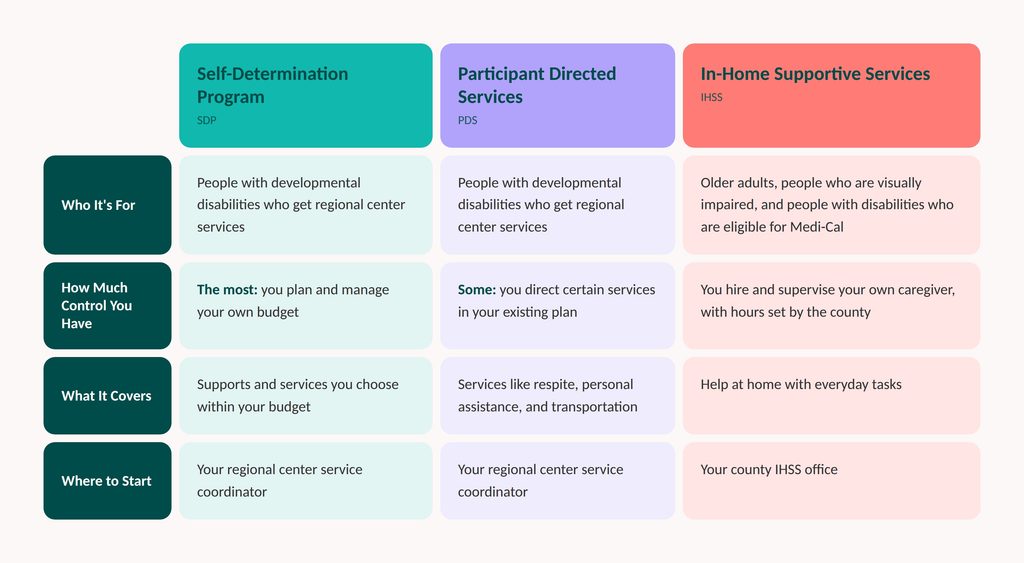
At PPL, we support SDP and PDS as a financial management services provider. IHSS works differently, since the state handles caregiver payroll, so it isn’t a program we support.
All About Financial Management Service Providers
A financial management services provider (often shortened to FMS) is an organization that handles the money side of self-directed care. When you direct your own services, you become your workers’ employer, which means someone has to run payroll, pay taxes, and keep the paperwork in order. An FMS does that for you, so you can focus on choosing your team and running your day.
What Does an FMS Do?
The details vary by program, but most FMS providers help with:
- Payroll. Your workers’ paychecks are processed using the budget approved for you.
- Taxes. Employment taxes, including federal, state, local, and unemployment, are withheld and paid for you.
- Enrollment. You and your workers get help with the forms, paperwork, and background checks needed to get started.
- Budget tracking. You can see how much you’ve used and how much is left, so there are no surprises.
- Reports. Regular summaries show what services you’ve received and what you’ve spent.
Do You Have to Use an FMS in California?
It depends on the program. In California’s Self-Determination Program, everyone must work with a state-approved FMS. In Participant Directed Services, an FMS handles payroll and paperwork for the workers you hire. In In-Home Supportive Services, the state issues caregiver paychecks directly, so there’s no separate FMS to choose.
For SDP and PDS, you get to pick your provider. California has about 28 approved FMS providers, and it’s a bit like choosing a doctor or a bank: they all do the same basic job, but the experience can feel pretty different.
What We Offer as an FMS in California
At PPL, we’re a financial management services provider for SDP and PDS, and we work with all 21 California regional centers. An enrollment specialist helps you and your workers get started, and our customer service team is available Monday through Friday, 8 am to 5 pm PT. We’ll support you in the language you speak, with interpretation available if we don’t have a staff member who speaks it.
We also have tools to make the day-to-day easier:
- Time4Care™ is a mobile app for iPhone and Android where workers log their hours and you review and approve them. It also handles electronic visit verification (EVV), which confirms when and where services happened. The state requires EVV for PDS.
- PPL@Home (for SDP) and BetterOnline (for PDS) are online portals where you can check your budget, see your approved services, and keep an eye on timesheets from any device with internet.
Join a Free Provider Spotlight Webinar for the Self-Determination Program
The Self-Determination Program (SDP) in California gives you a budget to build your own support team, but finding the right providers can be the hardest part. Our free Provider Spotlight Series is a virtual webinar that helps with exactly that. You meet providers from across California and hear about the services they offer.
Webinar Details
- What it is: CA SDP: Provider Spotlight Series, a free virtual webinar
- Next session: Wednesday, November 25, from 6:00 to 6:45 PM PT (9:00 to 9:45 PM ET)
- Who it’s for: Anyone exploring SDP, including people with developmental disabilities, family members, and caregivers
- Cost: Free
How to Get Started With Self-Directed Care in California
Where you start depends on the program. Here’s the first step for each one, along with who to contact.
Self-Determination Program
SDP runs through California’s regional centers, so your first step is to talk with your regional center service coordinator. If you don’t have a regional center yet, you can apply through the one that serves your area. Because SDP requires a financial management services provider, you’ll choose one as part of getting set up.
To get started with us:
- Phone: 844-902-6665
- Email: pplcalifornia@pplfirst.com
Participant Directed Services
PDS also starts with your regional center service coordinator. Here’s what the process usually looks like:
- Talk with your service coordinator about using PDS.
- Your regional center sends your referral to us.
- We set you up in our system and call you to schedule enrollment for you and your workers.
- You complete the enrollment forms, and we help your workers get set up to be paid.
- Your service coordinator makes sure your services are authorized.
- Services begin once you get a “Good to Go” status from us.
Workers aren’t paid for hours worked before that status is issued, so it’s worth waiting for it before anyone starts.
To get started with us:
- Phone: 1-833-202-6175 (TTY: 1-800-360-5899)
- Email: capds-cs@pplfirst.com
In-Home Supportive Services
IHSS is run through your county, so your county IHSS office is the place to start. You can ask questions, request an application, and schedule the home visit with a county social worker there. The application is available in many languages.
We don’t support IHSS, so we can’t help with enrollment or applications.
Activity Funds Initiative (Coming Soon)
The Activity Funds Initiative isn’t open for enrollment yet. When it launches, the first step will be to contact a licensed mental health professional through your county. If you have questions in the meantime:
- Phone: 855-388-4089
- Email: caactivityfunds-cs@pplfirst.com
Customer Service Hours
Our customer service team is available Monday through Friday, 8 am to 5 pm PT.
About PPL
At PPL, we’re a financial management services provider focused on one thing: helping people direct their own care. It’s the only work we do, and we’ve been doing it for decades. We support participants, caregivers, and the organizations that run self-directed programs in about 50 programs across the country, with more than 700,000 participant and caregiver relationships.
For participants and families, that means we help you enroll, set up your caregiver as an employee, and keep your budget on track. For caregivers, it means getting set up and paid correctly and on time, with taxes handled. And if you have a question along the way (and you probably will), our team is happy to help.
Explore All Programs By StateFrequently Asked Questions
Self-directed care in California is a way of receiving services where you choose and manage your own support workers, often with a set budget. The state offers several programs that work this way, including the Self-Determination Program (SDP), Participant Directed Services (PDS), and In-Home Supportive Services (IHSS). Which one fits depends on your age, your needs, and the kind of support you’re looking for.
Both programs are for people with developmental disabilities who receive regional center services, but they give you different levels of control. The Self-Determination Program (SDP) gives you an individual budget to plan and spend on the supports you choose. Participant Directed Services (PDS) lets you hire and supervise the people who provide certain services already in your Individual Program Plan.
Yes. In California’s In-Home Supportive Services (IHSS) program, you hire, train, and supervise your own caregiver, which makes you their employer. A county social worker decides which services you’re eligible for and how many hours the county will cover, and the state issues your caregiver’s paychecks. IHSS is for older adults, people who are visually impaired, and people with disabilities who are eligible for Medi-Cal.
A financial management services provider (FMS) handles the payroll, employment taxes, and paperwork that come with being an employer in a self-directed program. It can also help with enrollment, budget tracking, and reports. In California, everyone in the Self-Determination Program (SDP) must use a state-approved FMS, and you can choose from about 28 providers.